Backup Power · 8 min read · Updated 2026-07-23
Apartment Backup Power Basics
Figure out what you can safely keep running in an apartment outage before spending money on a battery.
✓Never run a fuel generator indoors, on a balcony, or near windows, doors, or vents.
✓Write the load list and required hours before choosing a battery.
✓Consumer batteries and UPS units are not substitutes for a device-specific medical power plan.
✓Plan what happens after the first charge is gone.
Start with the next few hours
Apartment backup is not whole-home backup in miniature. Renters usually cannot add transfer equipment, store fuel safely, mount permanent panels, or run noisy equipment away from neighboring windows. The useful target is smaller: communication, light, safe airflow, essential information, and enough charged electronics to make the next decision.
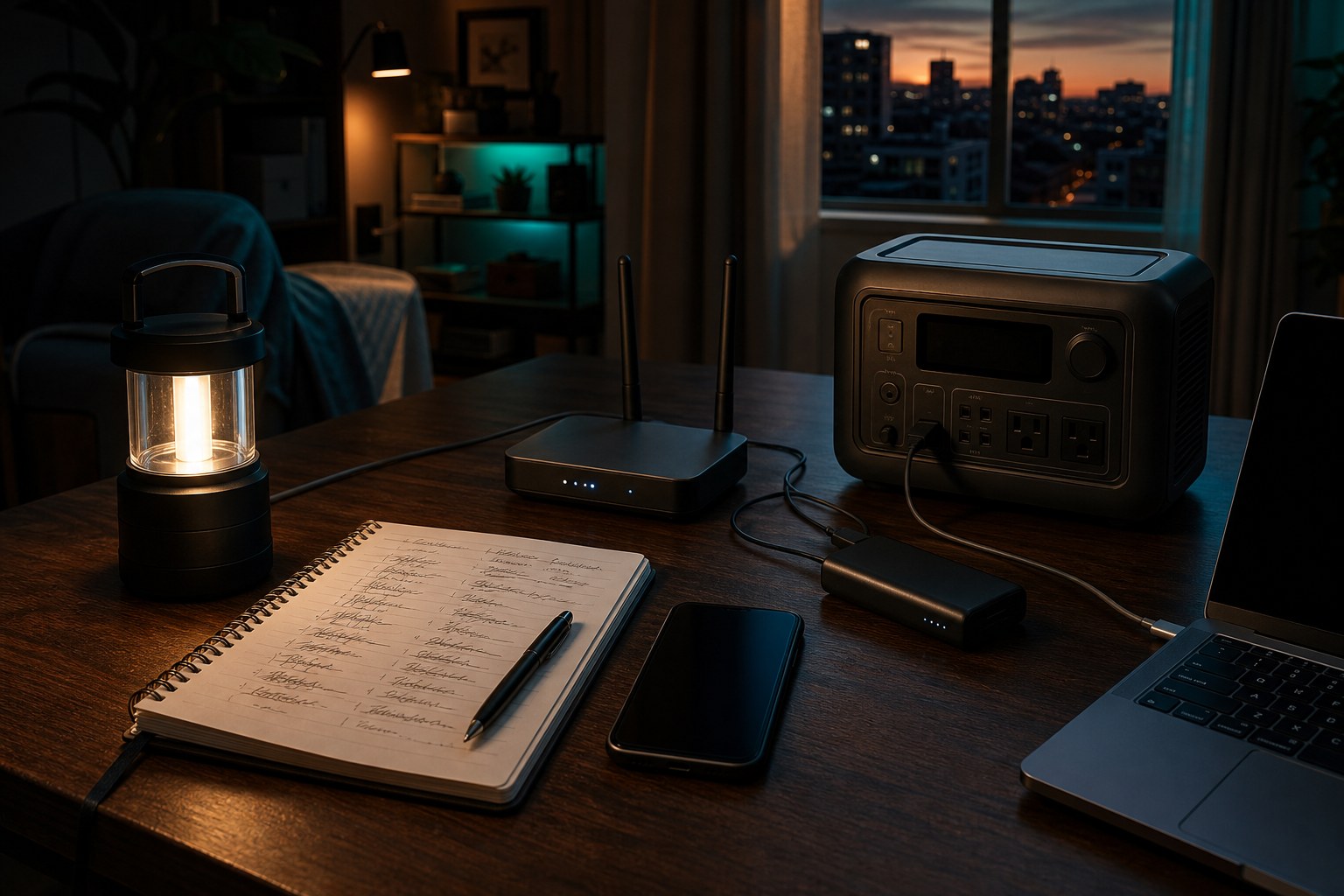
Write down what would materially change the first night. For many households that is a phone, modem, router, laptop, LED lantern, and small fan. Add any accessibility or health-related equipment only after checking its power requirements and emergency instructions with the manufacturer and care team.
Build the load list first
Record each device's running watts and the number of hours it matters. A plug-in power meter is better than guessing for AC devices. For USB devices, the charger label and battery capacity provide a planning estimate, but conversion losses mean a power station never delivers every advertised watt-hour to the load.
Multiply running watts by hours to estimate watt-hours, add the devices that may run together, then leave reserve capacity. A 20W network stack running for four hours needs about 80Wh before conversion losses. A 10W fan for eight hours needs another 80Wh. This simple list is more useful than shopping by the largest capacity number.
Know what the battery cannot do
Small power stations are good at electronics and efficient comfort loads. Heaters, kettles, hot plates, microwaves, portable air conditioners, and other heat-making appliances can exceed the inverter rating or empty a renter-scale battery quickly. A large capacity number does not guarantee the inverter can start every appliance.
Keep extension cords visible, fully uncoiled, correctly rated, and out of doorways or exit paths. Never backfeed an apartment circuit through an outlet. If a plan depends on changing building wiring, it requires building approval and qualified electrical work.
Treat medical power as its own plan
A consumer power station, UPS, or shopping-guide runtime estimate is not a medical backup system. If a person depends on a life-sustaining or medically necessary device, follow the device manufacturer's outage instructions, coordinate with the clinician or equipment provider, and know when to seek emergency services.
The FDA also recommends notifying the electric utility and local emergency services where appropriate, keeping device and backup-power instructions available, and planning how to relocate if safe operation cannot be maintained. Do not discover connector, alarm, or battery limitations during the outage.
Food, water, and indoor temperature
Keep refrigerator and freezer doors closed. CDC guidance says refrigerated food is generally safe for about four hours without power; a full freezer can hold a safe temperature for about 48 hours and a half-full freezer for about 24 hours if unopened. When in doubt, follow food-safety guidance rather than taste-testing.
Keep drinking water available and watch indoor temperature. During extreme heat, a fan is only a bridge: CDC says not to direct a fan at yourself when indoor temperature is above 90°F because it can increase body temperature. Know the route to a cooling location before the apartment becomes unsafe.
The hard no list
Never run gasoline, propane, or dual-fuel generators indoors or on an apartment balcony. CDC says portable generators should be at least 20 feet from windows, doors, and vents. A balcony cannot reliably provide that separation from your unit and neighboring units.
Avoid candles as the primary light plan, indoor combustion devices, improvised backfeeding, overloaded power strips, cords under rugs, charging gear on soft bedding, and any setup that blocks an exit. Outage equipment still needs ventilation and the clearances in its manual.
Recharge and maintenance
Battery capacity is only the first cycle. Plan how the station will recharge after day one: wall power when service returns, a vehicle if reliably accessible, or a compatible portable panel where rules and direct sun allow. Solar is usually a supplement for renters, not the only recharge path.
Every three months, charge the power station and power banks, test the router UPS, inspect batteries and cables, confirm lights work, and update the load list. Store equipment within its temperature limits and never use a swollen, leaking, damaged, or recalled battery.
Sources and further reading
Safety and technical claims were checked against the primary sources below on .
- CDC: What to do during a power outage ↗: Generator separation, food, water, and outage safety guidance.
- CDC: Preventing heat-related illness ↗: Fan-use limit and extreme-heat precautions.
- FDA: Medical devices and natural disasters ↗: Device-specific planning and emergency coordination.