Buyer Guide · 10 min read · Updated 2026-07-23
Best Portable Power Stations for Apartments
Choose a current power station that covers essential apartment loads without paying for unusable capacity.
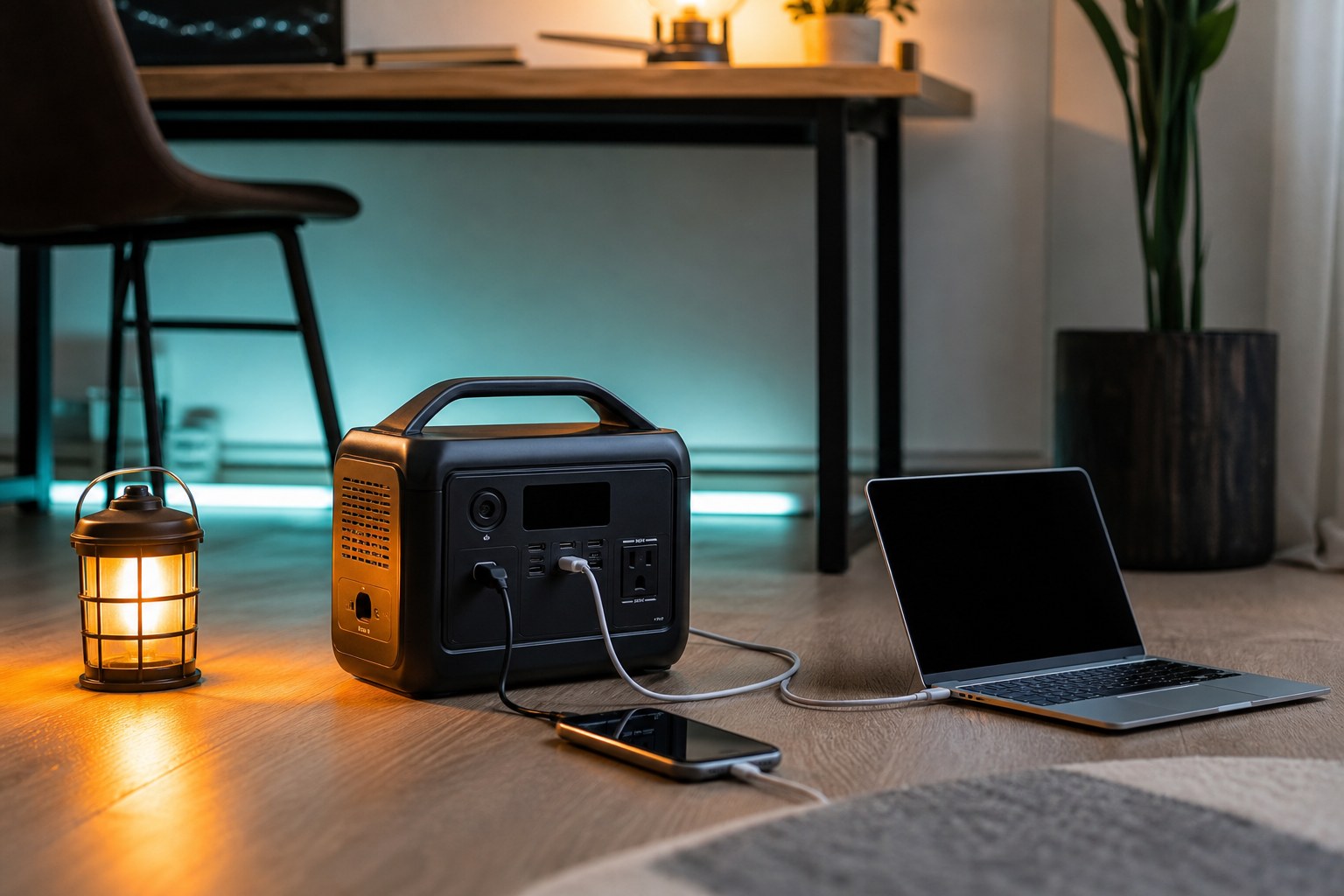
✓The Anker SOLIX C300 replaces the older Anker 521 recommendation.
✓Treat the EcoFlow RIVER 2 as a value pick when discounted, not the default.
✓Capacity determines endurance; inverter and port ratings determine what can run.
✓Published-spec picks are not hands-on tests, and current price must be checked at purchase.
Renter-fit shortlist
What to compare first.
Each pick lists who it fits and the main caveat before the buying link. Affiliate links may earn a commission.
Pick 1
Anker SOLIX C300 Portable Power Station
Best compact apartment station
Best for
Phones, laptops, router gear, LED lights, and other small electronics
Apartment fit
More current and more space-efficient than the older Anker 521 while staying easy to move and store.
Caveat: A 300W inverter is for electronics and efficient fans, not kettles, heaters, cooking gear, or portable air conditioning.
Published-spec pick · Checked
Current manufacturer model; retail stock and price vary.
Anker SOLIX C300 specifications ↗
Pick 2
BLUETTI Elite 30 V2
Best compact higher-output alternative
Best for
Renters who want 600W AC output without moving to a large-capacity station
Apartment fit
Compact enough for a shelf or closet while providing more inverter headroom than typical 300W-class stations.
Caveat: The higher inverter rating does not add stored energy: 288Wh still requires a conservative load and runtime plan.
Published-spec pick · Checked
Current 2026 manufacturer model; check regional retail availability.
BLUETTI Elite 30 V2 specifications ↗
Pick 3
BLUETTI AC70
Best larger apartment step-up
Best for
Longer fan, communications, and laptop runtime from one storable battery
Apartment fit
A major endurance upgrade that remains movable and closet-storable for many renters.
Caveat: More expensive and roughly twice the weight of compact picks; buy it only after the load list justifies the capacity.
Published-spec pick · Checked
Current manufacturer model; retail stock and price vary.
BLUETTI AC70 specifications ↗
Comparison table
Current portable power station shortlist
The compact picks emphasize storage and electronics; the AC70 is the larger endurance step-up. Exact sources and check dates are shown for every model.
Best compact apartment station
Anker SOLIX C300 Portable Power Station
- Best for
- Phones, laptops, router gear, LED lights, and other small electronics
- Key specs
- 288Wh LFP battery, 300W AC output, up to 140W USB-C output, 9.1 lb
- Apartment fit
- More current and more space-efficient than the older Anker 521 while staying easy to move and store.
- Main caveat
- A 300W inverter is for electronics and efficient fans, not kettles, heaters, cooking gear, or portable air conditioning.
- Evidence
- Published-spec pick · Checked · Current manufacturer model; retail stock and price vary. · Anker SOLIX C300 specifications ↗
Best compact higher-output alternative
BLUETTI Elite 30 V2
- Best for
- Renters who want 600W AC output without moving to a large-capacity station
- Key specs
- 288Wh LFP battery, 600W AC output, sub-30 dB rated operation, fast UPS transfer
- Apartment fit
- Compact enough for a shelf or closet while providing more inverter headroom than typical 300W-class stations.
- Main caveat
- The higher inverter rating does not add stored energy: 288Wh still requires a conservative load and runtime plan.
- Evidence
- Published-spec pick · Checked · Current 2026 manufacturer model; check regional retail availability. · BLUETTI Elite 30 V2 specifications ↗
Value pick when discounted
EcoFlow RIVER 2
- Best for
- A small electronics battery when its price is meaningfully below newer 288Wh models
- Key specs
- 256Wh LFP battery, 300W rated AC output, 600W X-Boost mode, 60W USB-C
- Apartment fit
- Light, compact, and easy to store for phone, router, light, and short laptop backup.
- Main caveat
- X-Boost is not a 600W surge rating, and newer compact stations offer more capacity, USB-C output, or quieter UPS behavior.
- Evidence
- Published-spec pick · Checked · Current manufacturer page remains live; treat as a value buy rather than the default. · EcoFlow RIVER 2 specifications ↗
Best larger apartment step-up
BLUETTI AC70
- Best for
- Longer fan, communications, and laptop runtime from one storable battery
- Key specs
- 768Wh LFP battery, 1000W AC output, two 100W USB-C ports, 950W AC charging, 500W solar input, 22.5 lb
- Apartment fit
- A major endurance upgrade that remains movable and closet-storable for many renters.
- Main caveat
- More expensive and roughly twice the weight of compact picks; buy it only after the load list justifies the capacity.
- Evidence
- Published-spec pick · Checked · Current manufacturer model; retail stock and price vary. · BLUETTI AC70 specifications ↗
These are published-spec recommendations, not hands-on tests. Live prices are intentionally not quoted because they change quickly. Check the exact model, current price, availability, included accessories, warranty, and return policy before buying.
The current starting point
For a new compact purchase, start with the Anker SOLIX C300. It replaces the older Anker 521 in this guide because it provides more capacity, much stronger USB-C output, and a more space-efficient current platform at a similar 300W AC class.
The BLUETTI Elite 30 V2 is the alternative when 600W of AC inverter headroom matters but the load list still fits a 288Wh battery. The EcoFlow RIVER 2 remains capable for small electronics, but it earns the recommendation primarily when its street price is clearly lower than newer compact options.
Choose capacity from the load list
Under roughly 300Wh is an electronics battery. It can cover phones, a laptop, router gear, LED lighting, or an efficient personal fan, but not all of them indefinitely. Plan around 80 to 85 percent usable delivery as a rough first estimate, then verify with the actual device and station.
Around 700 to 1000Wh creates a more flexible outage window for communications plus airflow and laptop work. The tradeoff is immediate: more cost, more weight, more storage volume, and longer solar recharge time. The AC70 is the step-up here because its extra capacity solves a different problem rather than merely raising inverter wattage.
Separate watts from watt-hours
Watt-hours describe stored energy. Watts describe how much power the inverter or port can deliver at once. A 288Wh station with a 600W inverter can start more devices than a 300W model, but a 500W load would still drain that small battery very quickly.
Check continuous AC output, not a boosted or power-lifting mode, against the device label. EcoFlow's 600W figure for the RIVER 2 is X-Boost, not a 600W surge specification. Boost modes can reduce voltage and are not suitable for every device.
Use USB-C when possible
A strong USB-C Power Delivery port can charge many laptops directly and avoids converting battery DC to AC and back through a laptop brick. That usually saves energy and cable clutter. The C300's up-to-140W USB-C capability is one of its clearest advantages over older compact stations.
Check the wattage of both the port and cable. A USB-C connector does not guarantee laptop-class power, and the low-power USB-C port on some UPS products is not equivalent to the USB-C PD output on a modern power station.
UPS mode has limits
Some portable stations advertise UPS or backup transfer behavior. Transfer time, grounding, waveform, fan behavior, and whether the feature is intended for continuous use vary. A fast transfer specification does not make a consumer station a medical-grade or zero-interruption power system.
For ordinary routers and computers, test the exact setup by removing wall power and confirming every required device stays online. For a device where interruption could cause harm, follow the device manufacturer's approved power guidance.
Recharge planning is part of the purchase
Fast wall charging matters because outages can be intermittent. If service returns for a few hours, a station that recharges quickly can recover before another interruption. Vehicle charging helps only if the vehicle and parking arrangement remain accessible.
A portable solar panel can help where there is direct sun, safe placement, and correct electrical compatibility. It should not be the only recharge plan for most renters. Window glass, shade, panel angle, wind, theft risk, cable routing, and building rules all reduce the neatness of the spec-sheet scenario.
What to skip
Do not size a compact station around a space heater, kettle, hot plate, microwave, portable air conditioner, or improvised apartment wiring. Heat-making appliances can exceed the inverter or consume the battery in minutes.
Also skip capacity bought only for reassurance. A battery that is too heavy to move, has no assigned storage location, or cannot be recharged in your real apartment is not resilience. It is expensive closet inventory.
Sources and further reading
Safety and technical claims were checked against the primary sources below on .
- FDA: Medical devices and natural disasters ↗: Why consumer power stations are not a substitute for device-specific medical planning.