Buyer Guide · 9 min read · Updated 2026-09-01
Best Small Fans for Power Outages
Compare three documented fan models for personal airflow, USB efficiency, or larger hybrid circulation.
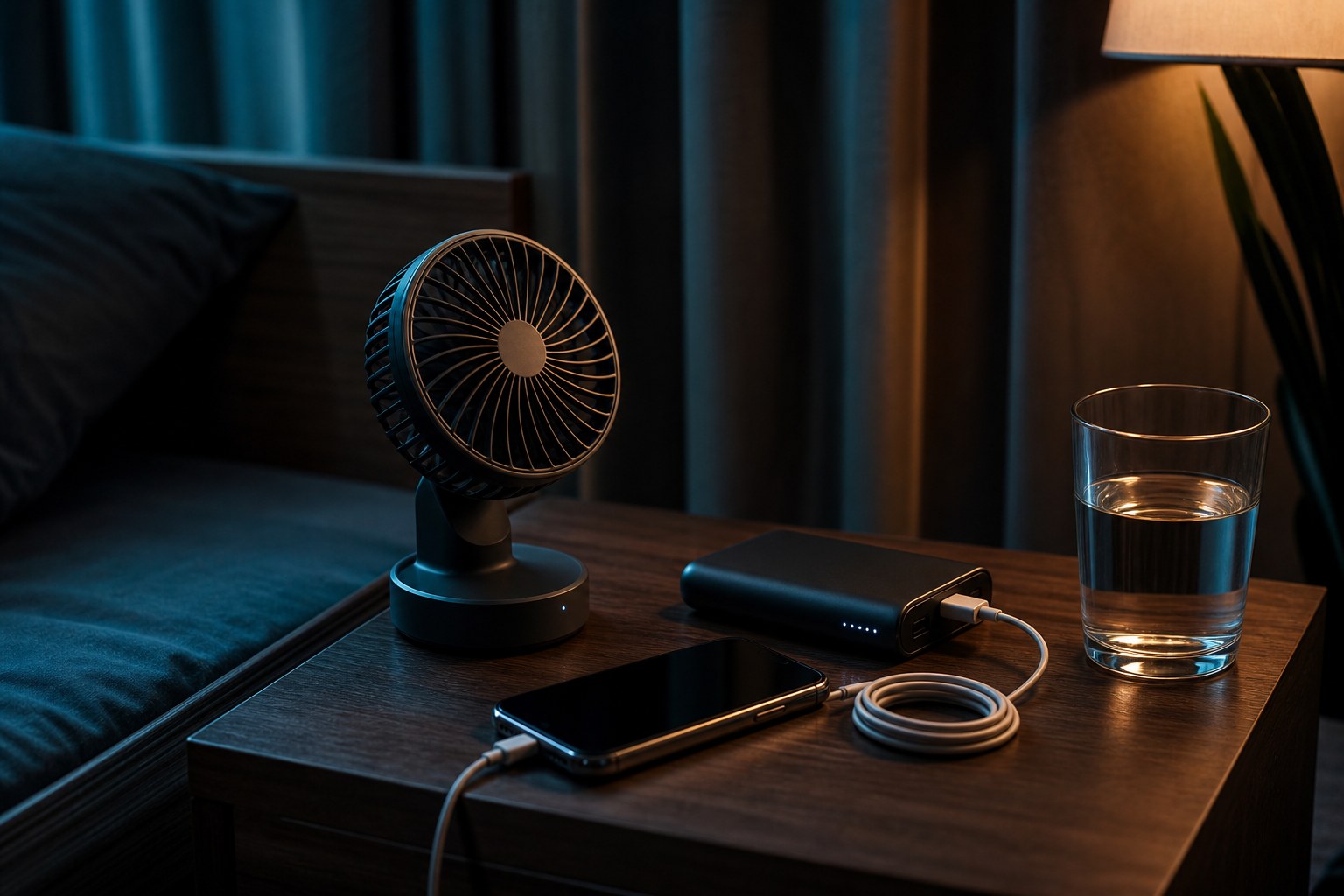
✓The guide now recommends named models with manufacturer-published specifications.
✓The Vornado FLY MOVE is the easiest self-contained personal pick.
✓The Vornado PEBL avoids an aging built-in battery by using external USB power.
✓CDC says not to direct a fan at yourself when indoor temperature is above 90°F.
Renter-fit shortlist
What to compare first.
Each pick lists who it fits and the main caveat before the buying link. Affiliate links may earn a commission.
Pick 1
Vornado FLY MOVE Rechargeable Fan
Best rechargeable personal fan
Best for
Bedside or desk airflow without keeping a power bank attached
Apartment fit
Compact, easy to aim, and simple to move between a bed, desk, and temporary cooling zone.
Caveat: The longest runtime is a low-speed claim; higher airflow shortens it, and this fan does not cool the room itself.
Published-spec pick · Checked
Current manufacturer model; retail stock and price vary.
Vornado FLY MOVE specifications ↗
Pick 2
Vornado PEBL Portable Desk Fan
Best USB-powered fan
Best for
Efficient personal airflow from a power bank or power station USB port
Apartment fit
Small footprint and no aging built-in battery; it can share the USB power already in an outage kit.
Caveat: It needs an external USB power source and provides personal airflow rather than room circulation.
Published-spec pick · Checked
Current manufacturer model; retail stock and price vary.
Vornado PEBL specifications ↗
Pick 3
RYOBI PCL811K1 18V Hybrid Fan Kit
Best larger hybrid fan
Best for
More room-scale airflow with the option to run from an 18V battery or AC outlet
Apartment fit
Useful if a larger fan earns the storage space or the apartment already uses RYOBI 18V batteries.
Caveat: Bulkier and more expensive than personal USB fans. Confirm the listing is the PCL811K1 kit, not the tool-only PCL811.
Published-spec pick · Checked
Current manufacturer kit model; retail stock and price vary.
RYOBI PCL811K1 kit specifications ↗
Comparison table
Small outage fan shortlist
These picks cover three different power strategies: built-in USB-C battery, external USB power, and hybrid 18V/AC operation.
Best rechargeable personal fan
Vornado FLY MOVE Rechargeable Fan
- Best for
- Bedside or desk airflow without keeping a power bank attached
- Key specs
- USB-C rechargeable, three speeds, rated for up to 17 hours of battery life
- Apartment fit
- Compact, easy to aim, and simple to move between a bed, desk, and temporary cooling zone.
- Main caveat
- The longest runtime is a low-speed claim; higher airflow shortens it, and this fan does not cool the room itself.
- Evidence
- Published-spec pick · Checked · Current manufacturer model; retail stock and price vary. · Vornado FLY MOVE specifications ↗
Best USB-powered fan
Vornado PEBL Portable Desk Fan
- Best for
- Efficient personal airflow from a power bank or power station USB port
- Key specs
- USB-powered, two speeds, compact tilting desk-fan format
- Apartment fit
- Small footprint and no aging built-in battery; it can share the USB power already in an outage kit.
- Main caveat
- It needs an external USB power source and provides personal airflow rather than room circulation.
- Evidence
- Published-spec pick · Checked · Current manufacturer model; retail stock and price vary. · Vornado PEBL specifications ↗
Best larger hybrid fan
RYOBI PCL811K1 18V Hybrid Fan Kit
- Best for
- More room-scale airflow with the option to run from an 18V battery or AC outlet
- Key specs
- 18V battery or AC power, three speeds, 160-degree pivoting head; kit includes battery and charger
- Apartment fit
- Useful if a larger fan earns the storage space or the apartment already uses RYOBI 18V batteries.
- Main caveat
- Bulkier and more expensive than personal USB fans. Confirm the listing is the PCL811K1 kit, not the tool-only PCL811.
- Evidence
- Published-spec pick · Checked · Current manufacturer kit model; retail stock and price vary. · RYOBI PCL811K1 kit specifications ↗
These are published-spec recommendations, not hands-on tests. Live prices are intentionally not quoted because they change quickly. Check the exact model, current price, availability, included accessories, warranty, and return policy before buying.
Pick the power strategy first
A rechargeable fan is self-contained and easy to place, but its built-in battery ages and maximum runtime usually assumes low speed. A USB-powered fan has no internal battery to maintain and can run from a power bank, but it consumes the shared USB reserve.
A hybrid tool-battery fan can move more air and swap batteries, but it costs more and occupies more storage. It makes the most sense when the household already owns compatible batteries or needs more than bedside airflow.
Best rechargeable: Vornado FLY MOVE
The FLY MOVE is the easiest starting point for a bed, desk, or chair. It charges over USB-C, offers three speeds, and Vornado rates it for up to 17 hours. Its value is portability and a simple self-contained setup.
Treat 17 hours as a best-case published maximum, not guaranteed high-speed runtime. Charge it during the same quarterly check as the outage kit and time the speed you would actually use for sleep.
Best USB-powered: Vornado PEBL
The PEBL uses external USB power and two simple speeds. That removes the built-in battery from the fan and lets the same power bank or station support it. It is a clean choice when personal airflow matters more than room circulation.
The tradeoff is dependence on a separate battery and cable. Include the fan in the overall watt-hour plan, keep the cable from crossing an exit path, and test whether its lower speed is useful enough for sleeping.
Best larger hybrid: RYOBI PCL811K1
The RYOBI PCL811 platform can use an 18V battery or AC power, has three speeds, and pivots through 160 degrees. The PCL811K1 kit includes the battery and charger; the PCL811 tool-only listing does not.
This is the larger, more expensive choice. It earns the footprint when the apartment needs stronger airflow or already uses RYOBI 18V batteries. Otherwise a personal fan is easier to store and usually stretches a small power reserve further.
Estimate runtime from watts
For an externally powered fan, divide usable battery watt-hours by measured fan watts. A 10W fan and 80Wh of usable battery imply roughly eight hours before accounting for varying speed and conversion behavior. Measuring the real fan is better than relying on blade size or marketing runtime.
Aim airflow at people, not the whole room. One efficient personal fan at the bed can be a better outage load than a larger fan trying to circulate an entire apartment.
Know the 90-degree limit
CDC says not to direct a fan at yourself when indoor temperature is above 90°F because the moving hot air can increase body temperature. A fan does not lower room temperature, and sweating becomes less effective in high humidity.
Use fans below that threshold with water, shade, breathable clothing, and reduced indoor heat. If the apartment keeps heating, move to an air-conditioned location. Plan that destination and transportation before the outage.
What this ranking does and does not mean
These are published-spec recommendations, not claims of hands-on airflow, noise, or battery testing. The shortlist favors clear manufacturer documentation, common power inputs, physical controls, apartment-scale storage, and a distinct reason to choose each model.
Before the return window closes, test stability, noise, indicator lights, cable reach, useful low-speed airflow, and actual runtime. A fan that looks efficient but cannot help you sleep does not belong in the kit.
Sources and further reading
Safety and technical claims were checked against the primary sources below on .
- CDC: Preventing heat-related illness ↗: The 90°F indoor fan-use limit and cooling precautions.