Solar · 8 min read · Updated 2026-07-23
Balcony Solar for Renters
Use a portable panel to charge a battery safely, and do not confuse it with plug-in solar that backfeeds an apartment circuit.
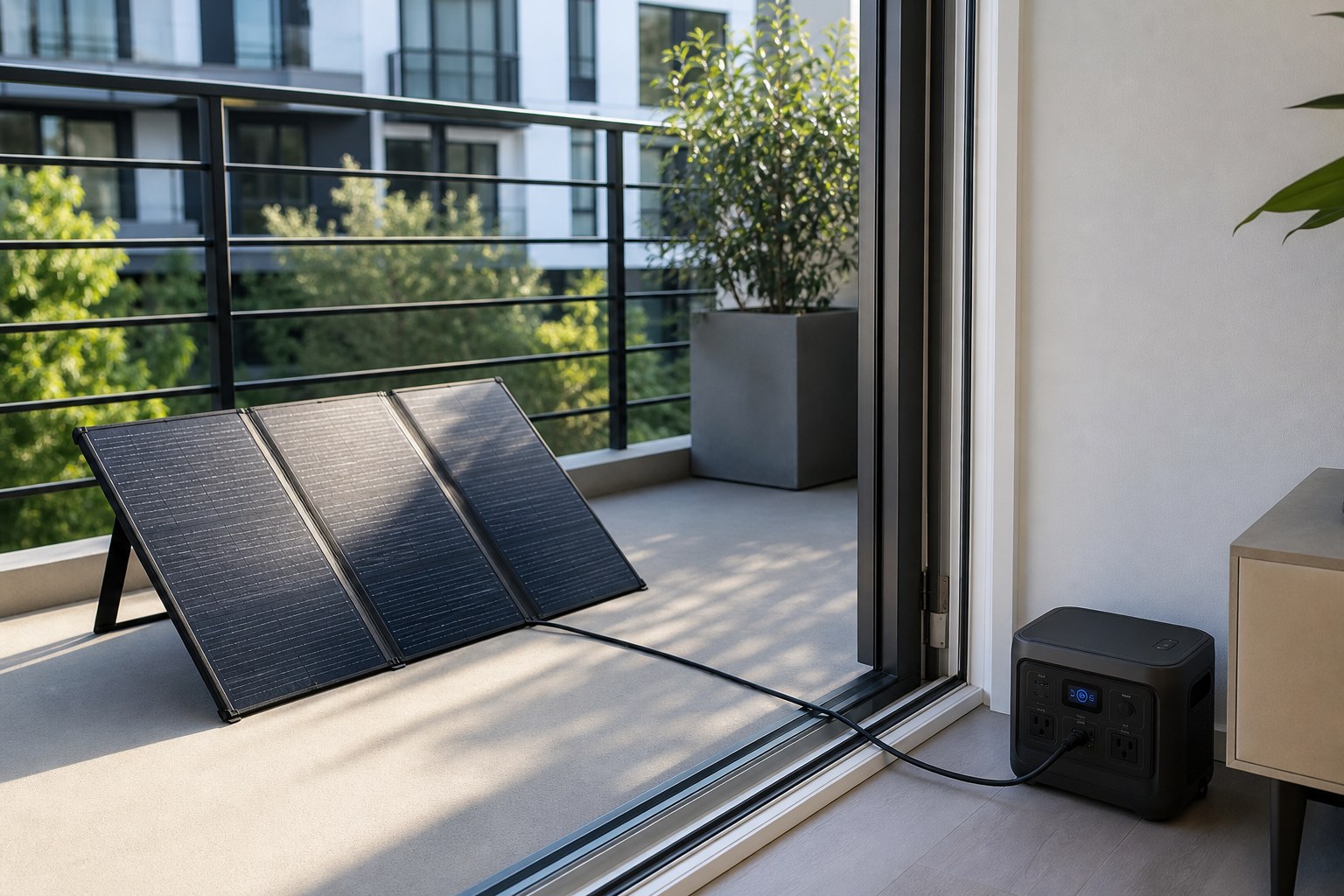
✓This guide means off-grid panel-to-battery charging, not plug-in grid-interactive solar.
✓Never connect a panel or inverter to a wall outlet unless a code-compliant, approved system explicitly permits it.
✓Match panel voltage, open-circuit voltage, current, power, polarity, and connector to the battery input.
✓Treat the 40 to 80W output from a nominal 100W panel as a planning range, not a guarantee.
Check rules and sun before hardware
Read the lease, building rules, balcony restrictions, and local fire requirements before buying. A portable panel still creates wind, falling-object, trip, cable, and facade concerns. Freestanding and removable is usually easier to approve than anything attached to a railing or exterior surface.
Then observe direct sun across several days. Orientation, neighboring buildings, balcony overhangs, trees, and seasonal sun angle can turn a highly rated panel into a poor purchase. Bright shade is not the same as direct sun.
Match the electrical input
The panel has to fit the power station's solar-input range. Check rated panel power, operating voltage, open-circuit voltage or Voc, current, connector, and polarity against the station manual. Cold weather can raise panel voltage, so Voc must remain below the station's maximum input voltage.
Do not assume a physically compatible plug is electrically compatible. Use manufacturer-approved cables or adapters where possible, keep connectors dry and undamaged, and never connect or disconnect improvised wiring under load.
Plan for less than the label
A nominal 100W panel may produce roughly 40 to 80W in decent apartment conditions, but that is a planning range rather than a measured promise. Heat, haze, window glass, partial shade, cable loss, bad angle, and charge-controller limits can reduce it further.
Four hours averaging 50W is about 200Wh before charging losses. That can materially replenish phones, lights, a router, and an efficient fan. It does not turn a balcony into whole-apartment generation.
Place and route it safely
A panel must be secured against wind without creating a falling hazard or damaging the building. Keep it within the manufacturer's temperature and weather limits. Do not leave a portable panel unattended where it can fall, be stolen, or obstruct firefighters or neighbors.
Route the cable without pinching it in a door or window, defeating weather seals, creating a trip path, or blocking an exit. Keep the power station indoors if the manual does not rate it for weather exposure, with ventilation clear and away from direct heat.
Decide whether solar earns the space
Portable solar is strongest as an outage recharge option or a hands-on way to understand energy. It is usually weak as an apartment bill-reduction strategy because panel area, direct-sun hours, placement rules, and storage constrain annual output.
Before buying, borrow a panel if possible or map direct-sun hours carefully. If the balcony is mostly shaded, spend the money on right-sizing the battery, lowering loads, or improving the wall-recharge plan instead.
Sources and further reading
Safety and technical claims were checked against the primary sources below on .
- UL Solutions: Plug-in solar certification framework ↗: The 2026 US framework distinguishing evaluated plug-in PV systems from improvised backfeeding.
- UL Solutions: Residential plug-in PV safety concerns ↗: Branch-circuit, shock, plug-blade, and GFCI concerns.