Buyer Guide · 10 min read · Updated 2026-09-01
Apartment Blackout Kit
Build a compact kit for communication, safe light, phone power, heat decisions, food safety, and the first hard night.
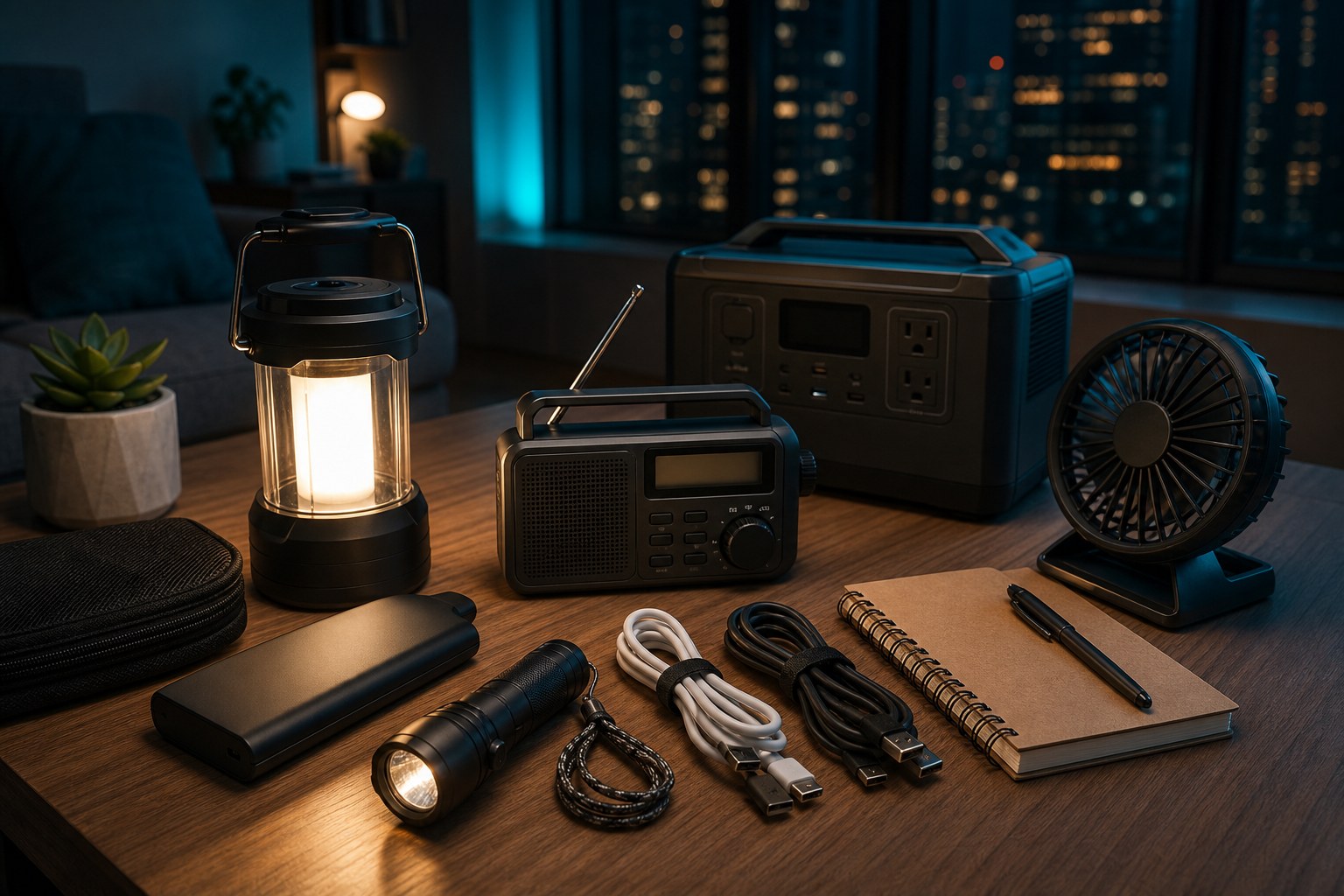
✓Build for the first 2 to 24 hours and a safe exit decision, not normal apartment life.
✓Use the Energizer WeatheReady lantern instead of an undocumented generic lantern.
✓The Midland ER310 is a radio, not a practical phone-charging bank.
✓Include water, food-safety timing, medication instructions, and a cooling destination.
Renter-fit shortlist
What to compare first.
Each pick lists who it fits and the main caveat before the buying link. Affiliate links may earn a commission.
Pick 1
APC Back-UPS BE600M1
Best conventional router UPS
Best for
A modem, router, fiber ONT, and brief emergency phone top-off
Apartment fit
A compact, familiar UPS with a user-replaceable battery that fits beside a desk, media cabinet, or fiber ONT.
Caveat: Even at a modest 50W load, published runtime is under an hour. Test the complete network stack and record the result.
Published-spec pick · Checked
Current manufacturer model; retail stock and price vary.
APC BE600M1 specifications ↗
Pick 2
Anker SOLIX C300 Portable Power Station
Best compact apartment station
Best for
Phones, laptops, router gear, LED lights, and other small electronics
Apartment fit
More current and more space-efficient than the older Anker 521 while staying easy to move and store.
Caveat: A 300W inverter is for electronics and efficient fans, not kettles, heaters, cooking gear, or portable air conditioning.
Published-spec pick · Checked
Current manufacturer model; retail stock and price vary.
Anker SOLIX C300 specifications ↗
Pick 3
Energizer WeatheReady Emergency Lantern
Best documented room lantern
Best for
Lighting a room or exit path without spending power-station capacity
Apartment fit
Uses easy-to-store replaceable batteries, has a glow-in-the-dark switch, and avoids open flame.
Caveat: Published maximum runtimes use D cells; do not expect the same output or endurance from AA batteries.
Published-spec pick · Checked
Current manufacturer model; retail stock and price vary.
Energizer WeatheReady lantern specifications ↗
Pick 4
Midland ER310 Emergency Crank Weather Radio
Best emergency radio layer
Best for
NOAA weather alerts and local information when phones or internet are unreliable
Apartment fit
Small enough for an outage bin and useful during storms when building internet is down.
Caveat: Midland says the small internal battery often cannot charge modern phones. Treat crank and solar as radio-resilience features, not a phone-power plan.
Published-spec pick · Checked
Current manufacturer model; retail stock and price vary.
Midland ER310 product page and FAQ ↗
Comparison table
Apartment blackout kit shortlist
This first layer prioritizes communication, phone power, documented lighting, and information. The larger battery is optional and load-driven.
Best conventional router UPS
APC Back-UPS BE600M1
- Best for
- A modem, router, fiber ONT, and brief emergency phone top-off
- Key specs
- 600VA / 330W, 7 NEMA outlets, one USB-A charging port; APC publishes about 51 minutes at a 50W load
- Apartment fit
- A compact, familiar UPS with a user-replaceable battery that fits beside a desk, media cabinet, or fiber ONT.
- Main caveat
- Even at a modest 50W load, published runtime is under an hour. Test the complete network stack and record the result.
- Evidence
- Published-spec pick · Checked · Current manufacturer model; retail stock and price vary. · APC BE600M1 specifications ↗
Best compact apartment station
Anker SOLIX C300 Portable Power Station
- Best for
- Phones, laptops, router gear, LED lights, and other small electronics
- Key specs
- 288Wh LFP battery, 300W AC output, up to 140W USB-C output, 9.1 lb
- Apartment fit
- More current and more space-efficient than the older Anker 521 while staying easy to move and store.
- Main caveat
- A 300W inverter is for electronics and efficient fans, not kettles, heaters, cooking gear, or portable air conditioning.
- Evidence
- Published-spec pick · Checked · Current manufacturer model; retail stock and price vary. · Anker SOLIX C300 specifications ↗
Best documented room lantern
Energizer WeatheReady Emergency Lantern
- Best for
- Lighting a room or exit path without spending power-station capacity
- Key specs
- 500 lumens, 3 D or 3 AA batteries, up to 30 hours on high or 90 hours on low with D cells, IPX4
- Apartment fit
- Uses easy-to-store replaceable batteries, has a glow-in-the-dark switch, and avoids open flame.
- Main caveat
- Published maximum runtimes use D cells; do not expect the same output or endurance from AA batteries.
- Evidence
- Published-spec pick · Checked · Current manufacturer model; retail stock and price vary. · Energizer WeatheReady lantern specifications ↗
Best emergency radio layer
Midland ER310 Emergency Crank Weather Radio
- Best for
- NOAA weather alerts and local information when phones or internet are unreliable
- Key specs
- AM/FM and NOAA weather radio with alert mode, flashlight, USB charging input, hand crank, and small solar panel
- Apartment fit
- Small enough for an outage bin and useful during storms when building internet is down.
- Main caveat
- Midland says the small internal battery often cannot charge modern phones. Treat crank and solar as radio-resilience features, not a phone-power plan.
- Evidence
- Published-spec pick · Checked · Current manufacturer model; retail stock and price vary. · Midland ER310 product page and FAQ ↗
Best budget phone backup
Anker 10,000mAh USB-C Power Bank
- Best for
- Keeping a phone alive without unpacking the main power station
- Key specs
- 10,000mAh capacity, USB-C, 5V / 3A class charging
- Apartment fit
- Small enough for an entry drawer, go-bag, or bedside table and useful outside outages too.
- Main caveat
- This is a basic phone battery rather than a laptop-class USB-C PD bank; verify cable and device compatibility.
- Evidence
- Published-spec pick · Checked · Current Amazon listing when checked; stock and price vary. · Amazon exact-model listing ↗
These are published-spec recommendations, not hands-on tests. Live prices are intentionally not quoted because they change quickly. Check the exact model, current price, availability, included accessories, warranty, and return policy before buying.
Build for the first hard night
The kit does not need to imitate grid power. It needs to keep communication and safe light available, preserve a phone, support tolerable airflow where appropriate, protect time-sensitive information, and make leaving possible. That is smaller, cheaper, and safer for renters.
Store everything in one known place. Another person should be able to use it without solving a cable puzzle in the dark. Label charging cables and battery types, include a printed load list, and keep exit, building, utility, and emergency information accessible offline.
Layer one: communication and phone power
Keep a charged 10,000mAh power bank, the correct phone cable, and a wall charger together. A separate phone bank prevents every short outage from consuming the larger station and stays useful for evacuation or travel.
Use a router UPS for automatic short-outage continuity if the provider network remains online. The APC BE600M1 is the conventional starting point, but published runtime at 50W is about 51 minutes. Test your complete network rather than writing 'all night' on the label.
Layer two: safe room light
Use battery LED lanterns instead of candles or household AC lamps. The Energizer WeatheReady model replaces the former generic lantern pick because the manufacturer publishes brightness, battery options, runtime, and water resistance.
Keep one light reachable from bed and one near the main exit path. Store the correct spare batteries outside the lantern if the manual recommends it, inspect for leaks, and do not mix old and new cells or battery chemistries.
Layer three: heat and water
Close blinds before direct sun enters, reduce indoor heat sources, wear breathable clothing, and keep drinking water available. A small efficient fan can help below 90°F indoors. CDC says not to direct a fan at yourself above 90°F because it can increase body temperature.
Know the route to a cooling center, conditioned lobby, friend, hotel, or other safe location. Older adults, infants, pregnant people, pets, and people with health conditions may need to leave sooner. A fan and battery buy decision time; they do not make dangerous indoor heat safe.
Layer four: food and medication
Keep refrigerator and freezer doors closed. CDC guidance uses about four hours for refrigerated food, 48 hours for a full freezer, and 24 hours for a half-full freezer if unopened. Keep an appliance thermometer if food loss is a recurring risk and discard unsafe perishables.
Store medication-specific outage instructions with the kit. For temperature-sensitive medicines or electrically powered medical devices, follow the manufacturer, pharmacist, clinician, and equipment provider. A consumer battery recommendation is not a substitute for an approved medical continuity plan.
Layer five: information
A weather radio adds a path that does not depend on home internet or a charged cell network. The Midland ER310 supports NOAA alerts, AM/FM, flashlight functions, and several ways to recharge its own small battery.
Do not count its crank or solar feature as phone backup. Midland's own FAQ says the internal battery often cannot charge modern phones. Use the radio for information and keep a dedicated power bank for the phone.
Add a power station only when justified
A compact station such as the Anker SOLIX C300 can combine longer phone, laptop, router, light, and efficient-fan support. Add the watt-hours from the measured load list and leave reserve. Do not buy it merely because an outage kit looks incomplete without a large battery.
Keep the station charged within manufacturer storage guidance, ventilated in use, away from exits and soft surfaces, and out of extreme temperatures. Stop using damaged, swollen, leaking, wet, overheated, or recalled battery equipment.
Quarterly maintenance
Every three months, charge power banks and stations, test the UPS, turn on every lantern and radio, inspect batteries and cables, update contacts, and replace expired supplies. Record actual runtimes so the next outage starts with household evidence rather than marketing estimates.
Leave out fuel generators, balcony combustion, extension cords under rugs, overloaded strips, candles as the primary plan, and gear that only works in an imaginary apartment with better sun, storage, vehicle access, or landlord permission.
Sources and further reading
Safety and technical claims were checked against the primary sources below on .
- CDC: What to do during a power outage ↗: Generator, food, water, and outage safety guidance.
- CDC: Preventing heat-related illness ↗: Fan-use limit and cooling guidance.
- FDA: Medical devices and natural disasters ↗: Medical-device continuity planning.